The National Center for Narrative Intelligence
The National Center for Narrative Intelligence (NCNI) advances Narrative Intelligence as a professional discipline through research, education, workforce development, policy, technology, and collaboration.
NCNI brings together government, academia, industry, researchers, educators, technologists, and practitioners to better understand how narratives emerge, spread, shape perception, influence behavior, and affect decisions.
FROM INFORMATION TO UNDERSTANDING
Established in 2023
Congressional & Academic Origins
Government, Industry & Academic Collaboration
A Growing Narrative Intelligence Community
What Is Narrative Intelligence?
Narrative Intelligence is the systematic understanding of how narratives form, move through information environments, influence audiences, and shape perception, behavior, and decision-making.
It brings together the analysis of information, narratives, actors, audiences, context, influence, and effects to help people and organizations understand not simply what is being said, but what it means, why it matters, and what may happen next.
Defining Narrative Intelligence
Narrative Intelligence is a multidisciplinary discipline for understanding the narratives that shape how people interpret the world.
It examines the ideas and stories moving through an information environment; the sources and actors advancing them; the audiences they reach; the conditions that cause them to gain or lose influence; and their potential effects on perception, behavior, and decisions.
It draws from fields including intelligence analysis, behavioral science, communications, linguistics, psychology, data science, information operations, and artificial intelligence to create a more complete understanding of narrative activity.
From Information Monitoring to Decision-Ready Understanding
Access to more information does not necessarily produce better understanding.
Traditional media monitoring and social listening can tell us what is being discussed, where activity is occurring, how much attention a topic is receiving, or how audiences are reacting. Narrative Intelligence goes further by examining the relationships among narratives, sources, actors, audiences, motivations, context, influence, and effects.
The objective is to transform complex information into understanding that can support better decisions.
Why Narrative Intelligence Matters
We live in an information environment where information moves faster, more actors can shape public understanding, and artificial intelligence can create and distribute content at unprecedented scale.
Organizations therefore face a growing challenge: understanding which narratives matter, why they are gaining influence, whom they are affecting, and what those narratives could mean for decisions and outcomes.
Narrative Intelligence provides a framework for making sense of that complexity.
Understanding Today's Changing Information Environment
Information environments are increasingly fragmented, interconnected, and dynamic.
News organizations, governments, companies, communities, influencers, individuals, automated systems, and AI-generated content all contribute to the narratives people encounter every day.
The challenge is no longer simply finding information. It is understanding how information connects, how narratives develop and compete, and which forces are shaping the way events and issues are understood.
How Narratives Shape Perception, Behavior & Decision-Making
Narratives provide the context through which people interpret information.
They influence what audiences notice, whom they trust, how they understand events, which risks they perceive, and ultimately how they respond.
For governments, narratives can influence public confidence, national security, policy, and international relationships. For businesses, they can affect reputation, markets, customers, employees, competitors, and strategic risk.
Understanding narrative dynamics therefore creates a clearer view of the environment in which decisions are made.
How Narrative Intelligence Works
Narrative Intelligence moves beyond individual posts, articles, messages, or data points to understand the larger narrative environment in which they operate.
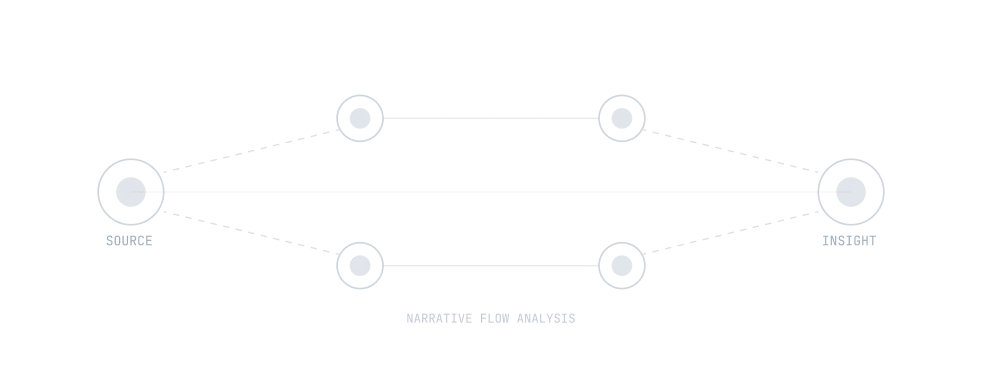
Raw information is not insight. Narrative Intelligence identifies the underlying narratives, tracks how they evolve, examines who is driving and amplifying them, and assesses their trajectory, significance, and potential effects.
Narrative Listening & Detection
Identify relevant narrative activity, information campaigns, emerging narratives, and early signals across the information environment.
Narrative Understanding & Analysis
Understand the narratives taking shape, who is driving them, how they are spreading, which audiences they are reaching, why they are gaining traction, and what they may mean.
Narrative analysis can help identify themes, actors, sources, audience dynamics, influence patterns, competing narratives, and potential measures of effect.
Narrative Intelligence for Action & Response
Turn narrative understanding into actionable insight that helps leaders and practitioners make better-informed decisions.
Depending on the mission or organization, that insight can support strategic communications, risk assessment, policy, influence operations, crisis response, reputation management, competitive intelligence, national security, and other decision-making environments.
Narrative Intelligence transforms digital information into understanding—and understanding into informed action.
Narrative Intelligence and Related Disciplines
Narrative Intelligence is inherently multidisciplinary.
It intersects with established fields that examine information, influence, intelligence, communications, behavior, risk, and decision-making. These disciplines provide important perspectives and applications within the broader study and practice of Narrative Intelligence.
Narrative Intelligence, Cognitive Warfare & Cognitive Security
Cognitive warfare and cognitive security focus on attempts to influence, disrupt, manipulate, or protect human perception and decision-making.
Narrative Intelligence helps practitioners understand the narratives, actors, audiences, and information dynamics operating within the cognitive environment—supporting both the identification of influence activity and the development of greater cognitive resilience.
Narrative Intelligence, Information Operations & Influence Operations
Information operations and influence operations use information and related capabilities to affect attitudes, behaviors, and decisions in support of strategic or operational objectives.
Narrative Intelligence provides a framework for understanding the narrative environment in which those operations occur, including competing narratives, audience perceptions, sources of influence, information campaigns, and potential measures of effect.
Narrative Intelligence and Open-Source Intelligence (OSINT)
Open-Source Intelligence identifies and analyzes publicly available information to produce intelligence.
Narrative Intelligence can build upon publicly available information by examining how sources, narratives, actors, and audiences interact—helping analysts move from collecting information toward understanding meaning, influence, and potential effects.
Narrative Intelligence and Strategic Communications
Strategic communications seeks to align communication with organizational objectives and audience understanding.
Narrative Intelligence helps communicators understand the existing narrative environment before deciding how to communicate within it—identifying audience perceptions, competing narratives, emerging risks, and opportunities for more informed engagement.
Narrative Intelligence for Competitive Intelligence & Risk Intelligence
Organizations operate within narrative environments just as governments do.
Narratives surrounding companies, industries, technologies, leaders, competitors, regulations, and markets can influence reputation, customer behavior, investment, policy, and strategic risk.
Narrative Intelligence helps organizations identify these dynamics earlier and understand their potential implications for decision-making.
About the National Center for Narrative Intelligence
The National Center for Narrative Intelligence is an independent center dedicated to defining, developing, and advancing Narrative Intelligence as a recognized professional discipline.
NCNI brings together government, academia, industry, researchers, educators, technologists, and practitioners to build the knowledge, standards, workforce, research, technology, and professional community required for the field to mature.
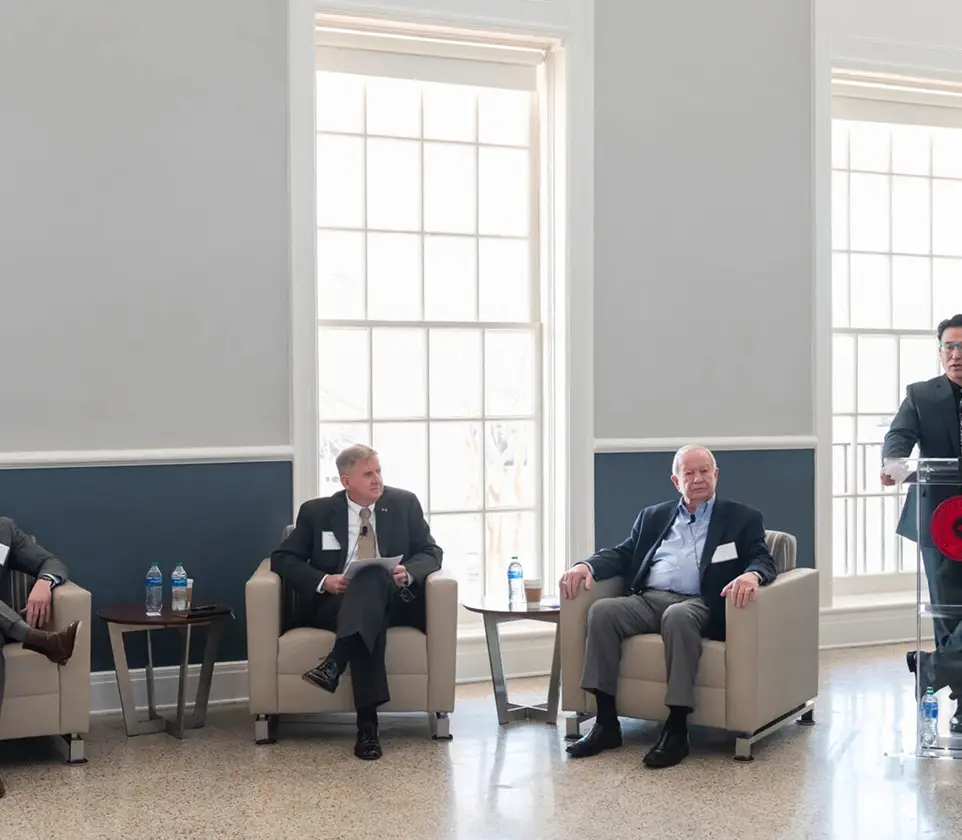
Policy Advocacy Forum — National Center for Narrative Intelligence
A National Hub for Narrative Intelligence
NCNI serves as a national hub for the study and advancement of Narrative Intelligence.
Through research, education, workforce development, policy engagement, professional collaboration, technology, and convening, the Center provides an institutional home for an emerging discipline that is increasingly important across government and commercial environments.
Defining and Advancing Narrative Intelligence as a Professional Discipline
Emerging professions require more than technology.
They require shared definitions, methodologies, research, standards, education, professional development, and communities of practice.
NCNI exists to help build that foundation—creating the intellectual and professional infrastructure needed for Narrative Intelligence to develop into an established discipline and profession.
Origins of the National Center for Narrative Intelligence
NCNI was created in response to the growing need for deeper understanding of how narratives influence people, organizations, institutions, and societies.
Its origins bring together congressional support, academic leadership, government expertise, industry innovation, and practitioners working across the information environment.
Established in 2023
The National Center for Narrative Intelligence was established in 2023 to advance the understanding and professional practice of Narrative Intelligence.
Congressional Support & Academic Origins
NCNI emerged with congressional support and academic incubation at the University of Mississippi, creating a foundation that connects public-sector needs with research, education, and professional development.
Government, Industry & Academic Collaboration
From its beginning, NCNI has brought together expertise from government, academia, and industry.
That collaborative model remains central to the Center's role: connecting researchers, practitioners, policymakers, educators, technologists, and organizations working to better understand the modern information environment.
Mission of the National Center for Narrative Intelligence
NCNI’s mission is to advance the understanding, practice, and impact of Narrative Intelligence through research, education, workforce development, policy engagement, technology, and collaboration.
The Center seeks to establish Narrative Intelligence as a recognized professional discipline while developing the knowledge, people, standards, methodologies, technologies, and partnerships necessary to apply it responsibly across government, industry, and society.
The Four Pillars of the National Center for Narrative Intelligence
NCNI advances its mission through four interconnected pillars supporting the research, workforce, policy, and partnerships required to strengthen the professional practice of Narrative Intelligence.

Narrative Intelligence Education & Workforce Development
NCNI develops a national cognitive security workforce through immersive training and partnerships linking students, government, and industry to strengthen U.S. information advantage and narrative intelligence.
Narrative Intelligence Research & Applied Research
NCNI conducts mission-focused research combining social science, technology, and defense to provide government and industry partners insights on narrative dynamics, influence campaigns, and AI-driven information threats.

Narrative Intelligence Policy, Standards & Cognitive Security
NCNI bolsters national strategy against cognitive threats through evidence-based frameworks, legal models, and policy guidance, equipping lawmakers, agencies, and allies with tools and briefings that protect democratic values.
Narrative Intelligence Partnerships & Collaboration
NCNI unites government, academia, and industry through summits, roundtables, and partnerships to shape policy, enhance interagency cooperation, and build national resilience in cognitive and narrative defense against information threats.
Narrative Intelligence Research, Frameworks & Publications
NCNI advances the field through research that expands the understanding of narratives, influence, information environments, cognitive security, emerging technologies, and the methodologies used to analyze them.
The Center's research connects academic inquiry with real-world challenges, helping translate emerging knowledge into frameworks and practices that can be used by professionals across government and industry.
Featured Narrative Intelligence Research
Explore NCNI research examining emerging narratives, influence activity, foreign malign influence, information environments, cognitive security, artificial intelligence, and the changing ways information affects people and institutions.
Narrative Intelligence Frameworks, Methodologies & Standards
A professional discipline requires common approaches for understanding and analyzing its subject.
NCNI works to advance frameworks, methodologies, terminology, standards, and best practices that provide practitioners with a more consistent foundation for Narrative Intelligence research and analysis.
AI, Technology & Innovation in Narrative Intelligence
Artificial intelligence and machine learning are transforming both the information environment and the methods used to understand it.
AI can accelerate the creation and distribution of information at unprecedented scale. It can also help researchers and practitioners analyze large volumes of publicly available information, detect influence activity, identify narrative patterns, map narrative flows, and better understand how information moves across complex environments.
NCNI works with technology and industry partners to explore how emerging technologies can responsibly strengthen Narrative Intelligence research, education, analysis, and decision support.
Narrative Intelligence Education, Training & Certification
Building Narrative Intelligence as a profession requires developing the people who will practice it.
NCNI works with academic institutions, government organizations, industry partners, educators, and practitioners to create educational pathways that move Narrative Intelligence from an emerging capability toward an established professional field.
Narrative Intelligence Training & Professional Development
NCNI develops training, workshops, courses, and experiential learning opportunities that help practitioners understand narrative dynamics and apply Narrative Intelligence concepts and methodologies to real-world challenges.
Professional Certification in Narrative Intelligence
Professional certification can help establish common knowledge, competencies, standards, and expectations for practitioners.
NCNI is advancing certification and professional-development pathways designed to support the continued maturation of Narrative Intelligence as a recognized profession.
Narrative Intelligence Academic & Workforce Partnerships
NCNI works with universities, government agencies, industry organizations, and other partners to expand Narrative Intelligence education, research, curriculum development, experiential learning, and workforce opportunities.
EdgeTheory Lab: Experiential Learning for Narrative Intelligence
The EdgeTheory Lab is an experiential learning environment that allows students, researchers, and practitioners to explore, test, and apply Narrative Intelligence in realistic scenarios.
The Lab complements NCNI's work in education, professional development, research, and certification by helping connect Narrative Intelligence concepts and methodologies to hands-on practice.
Practice Real-World Narrative Intelligence Scenarios
Apply Narrative Intelligence concepts to realistic scenarios, test assumptions, and examine outcomes in dynamic information environments.
Build Practical Narrative Intelligence Skills
Develop experience using tools and analytical approaches that connect classroom learning to applied practice.
Connect Learning With Real-World Application
Bridge academic concepts with practical application and real-world decision-making.
Frequently Asked Questions About Narrative Intelligence
What Is Narrative Intelligence?
Narrative Intelligence is the systematic understanding of how narratives form, move through information environments, influence audiences, and shape perception, behavior, and decision-making.
It examines narratives together with the actors and sources advancing them, the audiences they reach, the context in which they operate, and their potential influence and effects.
Why Is Narrative Intelligence Important?
People and organizations increasingly make decisions within complex information environments shaped by competing sources, narratives, communities, algorithms, artificial intelligence, and synthetic content.
Narrative Intelligence helps identify which narratives matter, understand why they are gaining influence, determine whom they may be affecting, and assess their potential implications for organizations, governments, markets, and society.
How Does Narrative Intelligence Work?
Narrative Intelligence combines listening and detection, understanding and analysis, and action and response.
It identifies narrative activity and emerging signals, analyzes how narratives form and spread, examines the actors and audiences involved, and transforms that understanding into insight that can support better-informed decisions.
How Is Narrative Intelligence Different From Media Monitoring and Social Listening?
Media monitoring and social listening typically identify mentions, conversations, trends, sentiment, engagement, and changes in attention.
Narrative Intelligence goes further by examining the narratives underlying that activity, the actors and sources driving them, the audiences they influence, the context in which they operate, and their potential implications.
How Does Narrative Intelligence Relate to Cognitive Warfare and Cognitive Security?
Cognitive warfare focuses on activities intended to affect human perception, cognition, behavior, and decision-making, while cognitive security addresses the protection and resilience of those processes.
Narrative Intelligence provides methods for understanding the narratives, actors, audiences, and information dynamics operating within that environment. Cognitive warfare and cognitive security are therefore important application areas of Narrative Intelligence, but they do not define the entire discipline.
How Does Narrative Intelligence Relate to Information Operations and Influence Operations?
Information operations and influence operations use information and related capabilities to affect audiences, perceptions, behaviors, or decisions.
Narrative Intelligence helps practitioners understand the narrative environment surrounding those activities, including competing narratives, actors, audiences, sources, context, influence, and potential effects.
How Does Narrative Intelligence Relate to Open-Source Intelligence (OSINT)?
OSINT focuses on collecting and analyzing publicly available information to produce intelligence.
Narrative Intelligence can use publicly available information but focuses specifically on understanding how narratives form and move, who drives them, which audiences they reach, why they gain influence, and how they may affect perception, behavior, and decisions.
How Is Artificial Intelligence Used in Narrative Intelligence?
Artificial intelligence can help analyze large volumes of information, identify emerging narrative activity, detect patterns, examine relationships among sources and actors, and support analysis of how narratives evolve and spread.
AI does not replace analytical judgment. It can help practitioners process information at a scale and speed that would be difficult to achieve manually.
What Is the National Center for Narrative Intelligence?
The National Center for Narrative Intelligence is an independent center dedicated to defining, developing, and advancing Narrative Intelligence as a recognized professional discipline.
NCNI brings together government, academia, industry, researchers, educators, technologists, and practitioners to advance research, education, workforce development, policy, standards, technology, and professional collaboration.
What Does the National Center for Narrative Intelligence Do?
NCNI advances Narrative Intelligence through applied research, education and training, workforce development, policy engagement, professional standards, technology and innovation, and collaboration across government, industry, and academia.
The Center also works to build the professional infrastructure—including shared definitions, methodologies, competencies, and communities of practice—needed for Narrative Intelligence to mature as a discipline.
Who Uses Narrative Intelligence?
Narrative Intelligence can support professionals working in intelligence, national security, defense, policy, strategic communications, public affairs, risk, reputation, competitive intelligence, research, academia, and organizational strategy.
Its common purpose is to help decision-makers better understand the narrative environment surrounding the issues that matter to them.
How Can Someone Become Trained or Certified in Narrative Intelligence?
NCNI is developing education, training, professional-development, and certification pathways designed to provide practitioners with the knowledge, methodologies, and competencies needed to work in Narrative Intelligence.
How Does the National Center for Narrative Intelligence Work With Government, Industry & Academia?
NCNI brings together government organizations, academic institutions, industry partners, researchers, educators, technologists, policymakers, and practitioners to advance Narrative Intelligence research, education, workforce development, technology, policy, and professional practice.
How Can Organizations Partner With or Support the National Center for Narrative Intelligence?
Government agencies, academic institutions, companies, researchers, educators, practitioners, and other organizations can engage with NCNI through research, education, workforce-development initiatives, partnerships, convenings, and support for the Center’s mission.
Understand the Narratives Shaping Our World.
Help advance the research, education, and expertise needed to understand how narratives shape perception, influence behavior, and affect decisions.
From information to understanding. From understanding to informed action.